A MAGA Legacy of Opposition
Introduction
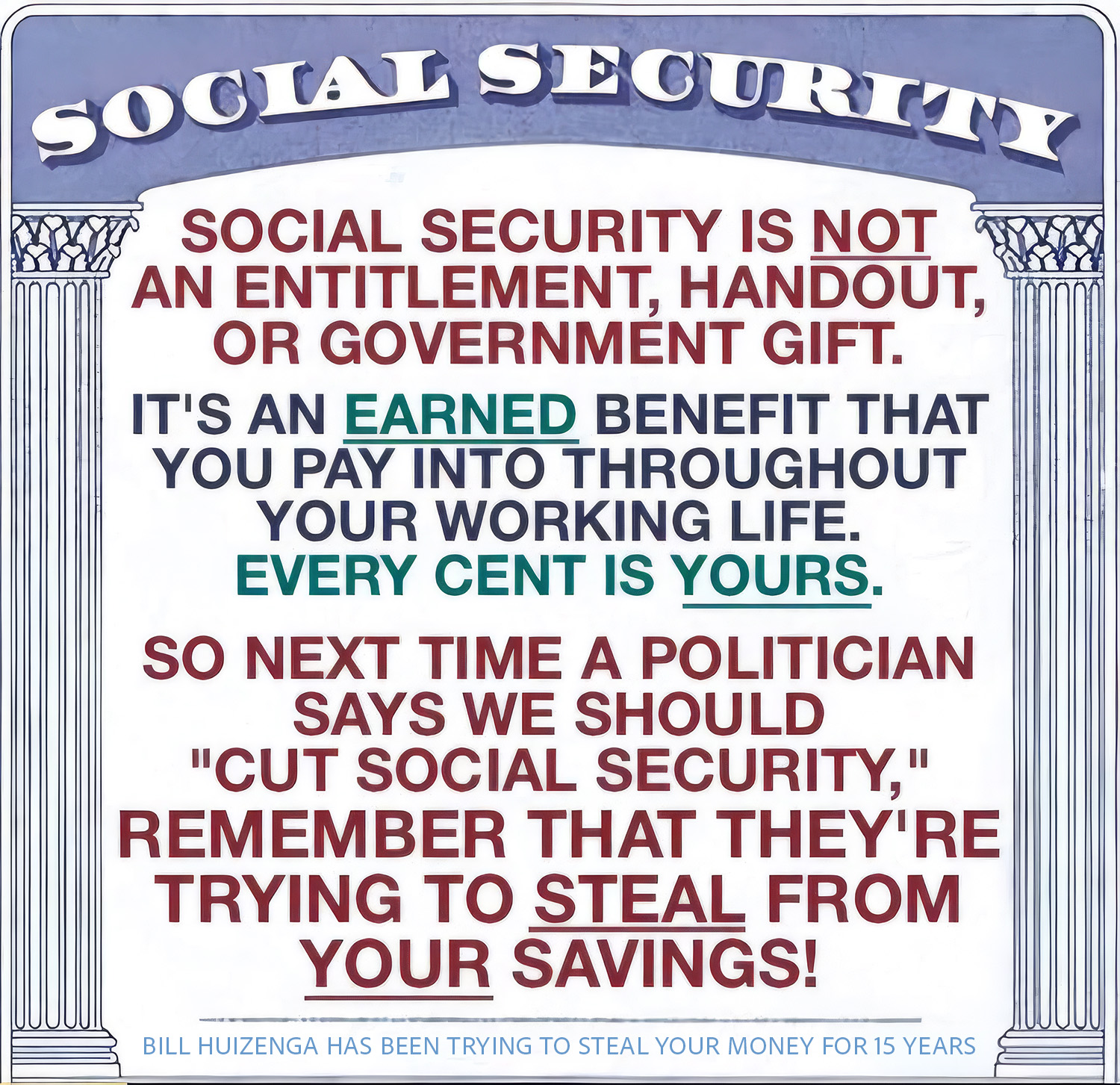
For nearly a century, Social Security has functioned as a cornerstone of financial security, allowing millions of Americans to retire with dignity. In Michigan alone, the program lifts more than 544,000 seniors out of poverty, with 63% of retirees relying on these earned benefits for at least half of their income. Despite the program’s massive popularity—79% of Michiganders state that earned benefits should not be reduced in any way—U.S. Representative Bill Huizenga (R-MI) has compiled a fifteen-year congressional record of advocating for and voting to restrict, privatize, and reduce these critical benefits. This sustained campaign directly threatens the retirement security of over 178,000 Social Security recipients in Michigan’s 4th Congressional District.
Incremental Reductions and Raising the Retirement Age
A primary strategy in Huizenga’s effort to scale back Social Security is the incremental raising of the full retirement age. Between 2011 and 2017, Huizenga voted five times for Republican budget proposals that would gradually increase the Social Security full retirement age to 69. When defending these proposals in a 2011 television interview, Huizenga dismissed the personal impact of such cuts, stating, “I’m 42. I’ll be 106 when these recommendations, if we adopted them right now, would actually come into place. I’m gonna be ok”.
This dismissive approach has persisted into recent years. During a telephone town hall last October, Huizenga continued to float cuts under the guise of younger generations needing to make “adjustments”. Pointing to his children’s generation, Huizenga argued that the system “was never built” for retirees to live as long as they work, suggesting they must make “adjustments in their qualifications, or in how long they’re going to work”. To further restrict expenditures, he additionally floated a mechanism where high-earning individuals could “voluntarily” forfeittheir Social Security and Medicare coverage.
The Push for Privatization and Far-Right Endorsements
Beyond direct benefit reductions, Huizenga has aligned himself with structural overhauls aimed at privatizing the public safety net. Most notably, Huizenga voted for the “Big, Ugly Law”. According to Treasury Secretary Scott Bessent, this legislation operates as a “backdoor for privatizing Social Security”. The Chief Actuary has warned that as a direct consequence of this law, the Social Security trust fund is projected to run out of money faster than previous estimates indicated.
Huizenga’s privatization agenda is further evidenced by his close alignment with extreme interest groups. In 2026, Huizenga accepted an award from the “60 Plus Association,” posing for photos with its President, Saul Anuzis. Established in 1992 with seed money from conservative megadonors Charles and David Koch, the 60 Plus Association proudly boasted in 1997 that it was “the first national senior citizens group to endorse privatization of the Social Security program”. Policy experts caution that privatizing the program would threaten its long-term solvency, effectively gutting retirement security to benefit Wall Street financial interests.
The Balanced Budget Amendment Threat
Huizenga has also worked to restrict Social Security funding through legislative mechanisms, particularly as a founding member of the Balanced Budget Amendment Caucus. A constitutional balanced budget amendment would legally prohibit the federal government from spending more than it generates in tax revenue in any single year.
While framed as a measure to curb spending, policy analysts at the Center on Budget and Policy Priorities (CBPP)warn that a balanced budget amendment would have catastrophic consequences for Social Security recipients. Specifically, it would make it unconstitutional for the Social Security Administration to draw upon its $2.56 trillion trust fund reserves to pay out promised benefits. This would trigger immediate “funding cliffs,” forcing drastic and immediate benefit cuts because all outlays would be strictly capped by the tax revenue collected in that same year. Huizenga has consistently backed these measures, voting for balanced federal budget requirements in March, and voting in April 2018 to block a motion that would have explicitly exempted Social Security, Medicare, and Medicaid from balanced-budget reductions.
Administrative Erosion and Disability Cuts
Finally, Huizenga has supported the hollowing out of the program’s administrative capacity and safety net features. He submitted fully to the DOGE effort led by Elon Musk, a sweeping initiative that slashed agency resources, cut phone lines, fired staff, and laid off workers. These severe cuts have cost Social Security offices an estimated 20% of their staff, degrading the agency’s ability to serve retirees and disabled individuals. Furthermore, Huizenga has fallen in line behind administration proposals to cut disability benefits. These proposed cuts to Supplemental Security Income directly threaten the 244,487 Michiganders who rely on disability benefits to survive.
Conclusion
While Huizenga’s office maintains that he is working with colleagues to protect benefits and prevent automatic cuts, his legislative record of the last fifteen years tells a different story. From voting repeatedly to raise the retirement age and supporting backdoor privatization to advocating for balanced budget rules that would cut off trust fund reserves and backing severe administrative layoffs, Huizenga has consistently advanced policies that weaken and undermine the Social Security system. For the millions of Michiganders who rely on these earned benefits for poverty relief and retirement security, these ongoing efforts represent a direct threat to their financial survival.
Social Security By The Numbers:
- 2,381,255 Michiganders receive Social Security.
- 244,487 Michiganders receive Supplemental Security Income (disability benefits).
- 63% of retirees rely on Social Security for at least half of their income.
- Social Security lifts more than 544,000 Michigan seniors out of poverty.
- 79% say Social Security earned benefits shouldn’t be reduced in any way.